A garage that feels like a refrigerator limits how you use your home. It can make morning departures unpleasant, put stored items at risk, and turn a workshop, home gym, or hobby space into a room you avoid for half the year. The best garage heating options depend on how often you use the space, whether it is insulated, and what energy sources are already available.
For most homeowners, the right answer is not simply the heater with the highest output. A dependable garage heating plan accounts for safety, operating cost, installation requirements, and how quickly you need the room to warm up. Here is how the main options compare.
Best Garage Heating Options: Start With the Space
Before choosing equipment, consider the garage itself. A two-car garage with uninsulated walls, an older overhead door, and frequent door openings will lose heat quickly. Even a powerful heater can struggle if it is trying to warm cold concrete, leaking air, and exposed framing at the same time.
Insulation is often the first upgrade worth making. Insulating exterior walls, adding weatherstripping around the garage door, sealing obvious gaps, and insulating the ceiling below living space can reduce heating demand significantly. If the garage door is old or poorly sealed, improving it may make a bigger comfort difference than installing a larger heater.
You will also need to think about the garage’s purpose. A space used for parking and occasional projects needs a different solution than a finished garage used every day as a workshop or recreation area. The more regularly you heat it, the more efficiency and control matter.
Gas Unit Heaters for Fast, Powerful Heat
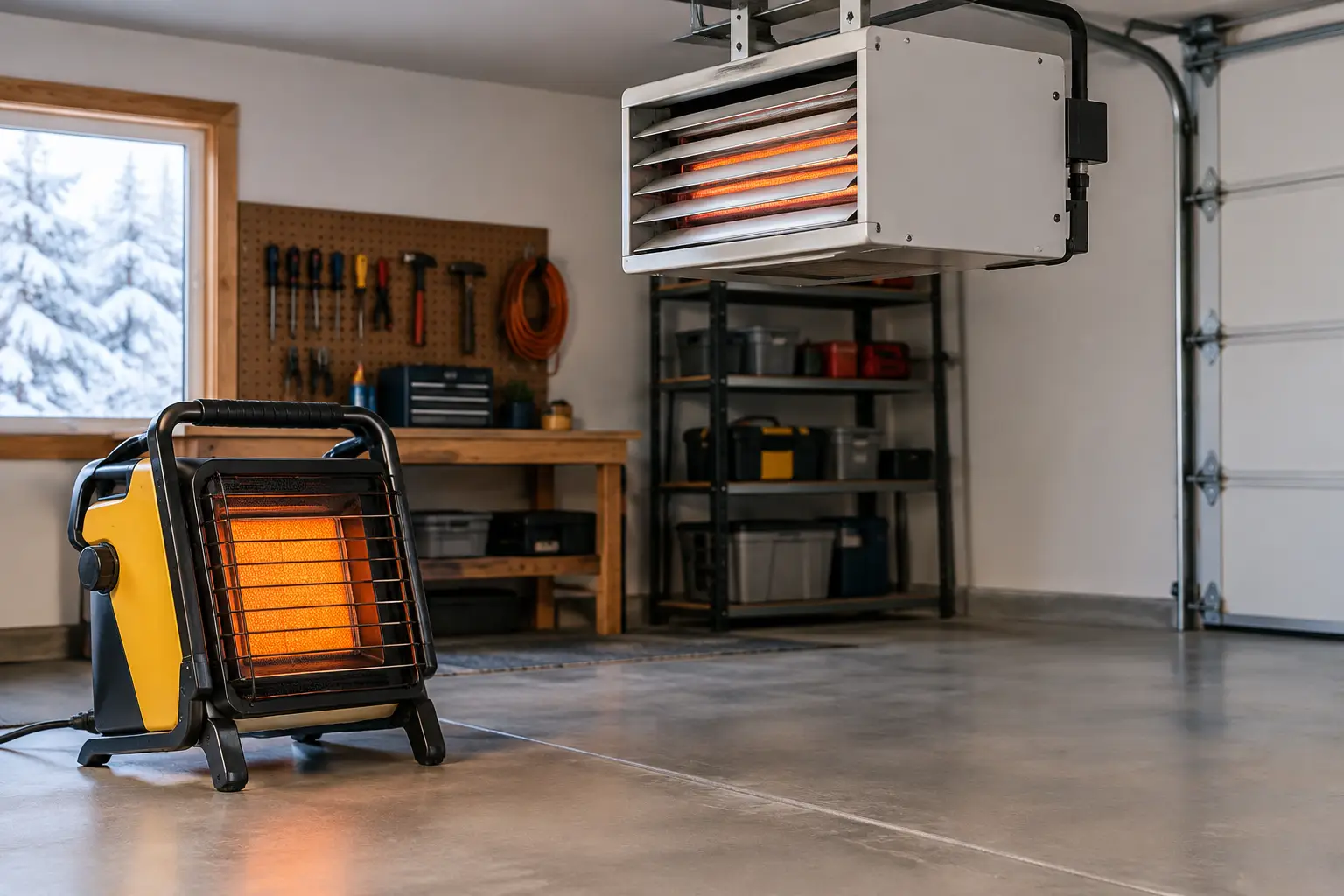
A ceiling-mounted gas unit heater is a popular choice for homeowners who need serious heat in a larger garage. It uses natural gas or propane and blows warm air into the room, bringing temperatures up quickly even when the space starts out cold.
This option works especially well for detached garages, large workshops, and garages that are opened frequently. Because the heater is mounted overhead, it preserves floor space and keeps equipment out of the way of vehicles, tools, and storage.
The trade-off is installation complexity. A gas unit heater needs properly sized gas piping, electrical service, venting, and professional combustion setup. Venting and clearances are not areas to guess at, particularly in a space where gasoline, paint, solvents, and other flammable materials may be present. Annual maintenance is also a smart investment to keep the burner, venting, and safety controls working properly.
For homeowners who use the garage several times a week, gas heat can offer a practical balance of quick comfort and reasonable operating costs. The best fit depends on local utility rates and the condition of the building envelope.
Electric Garage Heaters for Simple, Targeted Comfort
Electric garage heaters are straightforward, compact, and effective for smaller spaces or occasional use. They can be wall-mounted, ceiling-mounted, or portable, depending on the model and electrical capacity available.
A hardwired electric unit heater is generally a better long-term choice than a plug-in portable heater for a regularly used garage. Hardwired models deliver more consistent output and eliminate the risks that come with overloaded outlets, extension cords, or heaters placed too close to combustible materials.
Electric heat has no combustion gases and does not require venting, which can simplify installation. It is a sensible choice when gas service is unavailable or when the garage is modest in size and only needs heat for a few hours at a time.
Operating cost is the main consideration. Electric resistance heat converts electricity to heat efficiently at the unit, but electricity can cost more than natural gas per unit of heat. In a drafty, oversized, or constantly used garage, an electric heater may be expensive to run. In a well-insulated one-car garage used for weekend projects, it can be an easy and effective solution.
Ductless Mini-Splits for Heated and Cooled Garages
If your garage functions as more than a parking space, a ductless mini-split heat pump deserves a close look. These systems provide heating in winter and air conditioning in summer, making them especially useful for workshops, home gyms, finished hobby rooms, and garages with temperature-sensitive equipment.
Rather than creating heat through electric resistance coils or burning fuel, a heat pump moves heat from outdoors to indoors. That process can use less energy than standard electric heat, particularly during moderate winter conditions. Modern cold-climate models can continue to provide useful heat in low outdoor temperatures, although capacity and efficiency decline as conditions become more severe.
Mini-splits deliver steady, even comfort instead of the intense blast of heat from a unit heater. They are also quiet and provide excellent temperature control. The indoor head mounts high on a wall, while the outdoor unit sits outside the garage.
This is usually a higher upfront investment than a basic electric heater. It also requires professional sizing and installation. An oversized system may cycle too frequently, while an undersized system may not keep up on colder days. If the garage is poorly insulated or the door is opened constantly, address those issues before expecting any heat pump to perform at its best.
Radiant Floor Heating for Long-Term Garage Comfort
Radiant floor heating warms the concrete slab itself, creating one of the most comfortable garage environments available. Instead of heating the air first, it sends warmth upward from the floor. That means warm feet, fewer cold spots, and less heat collecting near the ceiling.
Hydronic radiant systems circulate warm water through tubing in or beneath the slab. They can often be connected to a compatible boiler or dedicated heat source. Electric radiant systems are another possibility, though they are generally better suited to smaller areas because of operating costs.
Radiant heat is ideal when building a new garage, pouring a replacement slab, or completing a major renovation. Installing it in an existing finished garage can be more involved and costly. It also responds more slowly than forced-air equipment, so it is best for spaces kept at a stable temperature rather than garages heated only on demand.
For a homeowner who spends significant time in a garage workshop, radiant flooring can be a premium upgrade that changes how the room feels year-round.
Can You Extend Your Home’s Existing HVAC System?
It may seem convenient to run a supply duct from the home furnace into the garage. In most cases, that is not a good idea, and local building codes commonly restrict it. Garages can contain vehicle exhaust, fuel vapors, chemicals, and other contaminants that should not be connected to the home’s air distribution system.
A separate heating solution is typically safer and easier to control. It lets you heat the garage only when needed without affecting temperatures throughout the home. If you are considering any connection to existing equipment, have a qualified HVAC professional assess the design, code requirements, and ventilation needs first.
Safety Details That Should Never Be Optional
Garage heating equipment needs more than enough capacity. It needs the right installation location, electrical protection, fuel connections, venting, and clearances. Portable heaters deserve special caution because garages often contain cardboard, rags, paint, gasoline containers, and clutter that can create a fire risk.
Keep any heater clear of stored materials, never use an oven or grill to warm a garage, and do not run unvented combustion equipment in an enclosed space. Carbon monoxide alarms are a wise safeguard when gas-fired equipment is installed nearby. If you work with flammable liquids or create dust from woodworking or refinishing, discuss those conditions before selecting a heater.
A professional assessment also prevents common sizing mistakes. Heater capacity should reflect square footage, ceiling height, insulation levels, climate, window area, and how often overhead doors open. Bigger is not automatically better. Equipment that is properly matched to the space provides more dependable comfort and avoids unnecessary energy use.
Choose Heat That Matches How You Live
For occasional use in a small, insulated garage, a properly installed electric heater may be all you need. For a busy workshop or larger garage that must warm up quickly, a gas unit heater is often the practical choice. For a finished space you use through every season, a ductless mini-split can deliver efficient heating and cooling. And for a major build or renovation, radiant floor heating offers exceptional long-term comfort.
The best choice begins with an honest look at the garage, not a guess based on heater size alone. A qualified local HVAC professional can evaluate insulation, fuel availability, electrical capacity, ventilation, and your comfort goals before recommending equipment. Pro West Heating & Air Conditioning can help homeowners make that decision with clear options, professional installation, and a solution built for the way the garage is actually used.