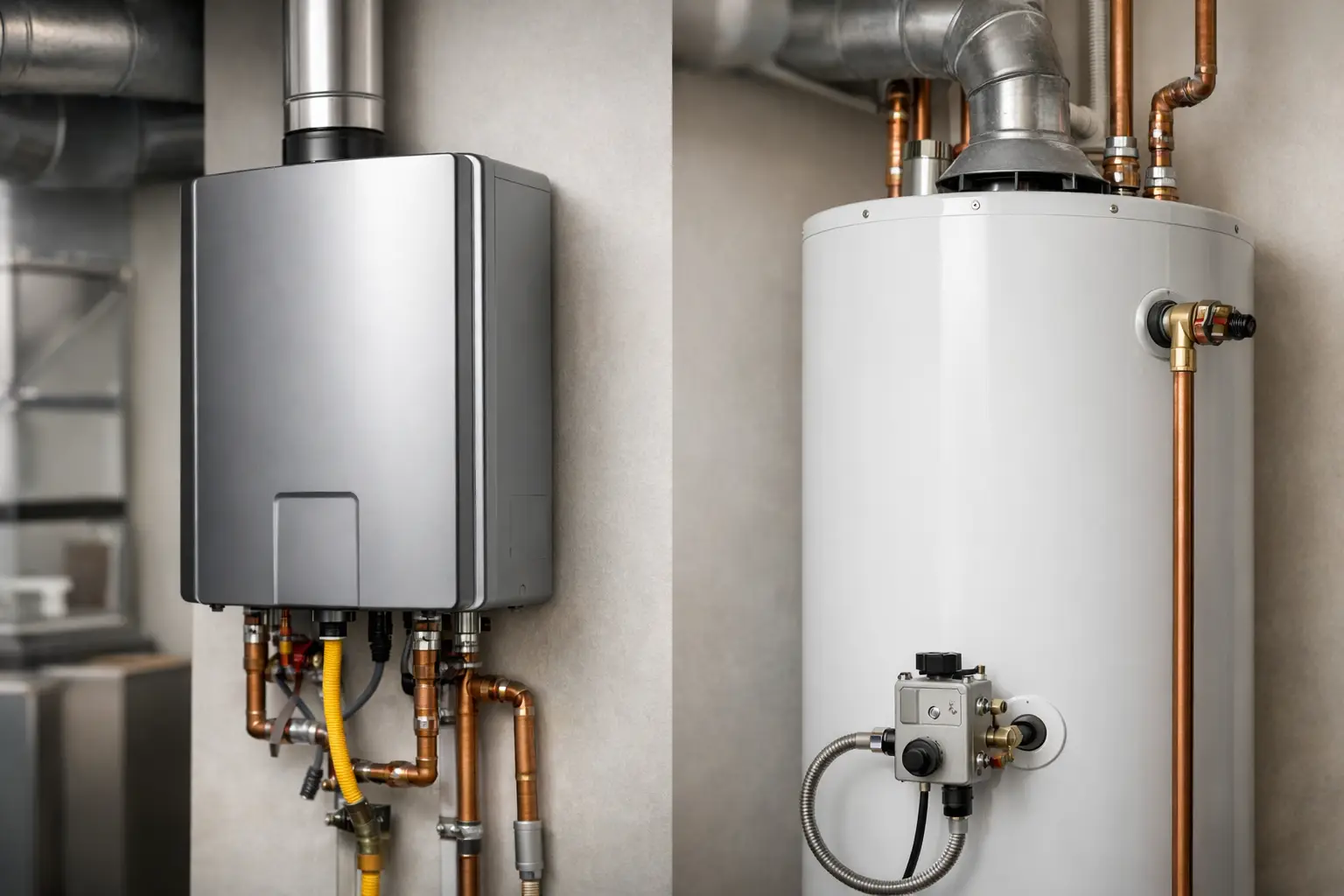
A water heater rarely gets much attention until the shower turns cold, the utility bill climbs, or a leak appears around the base of the tank. When replacement time arrives, the tankless versus tank water heater decision can affect your family’s comfort, your available space, and your long-term energy costs for years to come.
There is no single winner for every household. A tankless unit can provide hot water on demand and free up valuable floor space. A traditional storage tank often costs less to install and can be the practical choice for many homes. The right answer comes down to how your household uses hot water, the condition of your existing equipment, and what your home can support.
Tankless Versus Tank Water Heater: The Core Difference
A traditional tank water heater stores a set amount of heated water, commonly 40 to 75 gallons. It keeps that water warm until someone opens a hot-water tap. As hot water leaves the tank, cold water enters and is heated for the next use.
A tankless water heater heats water only when you need it. When a shower, faucet, dishwasher, or washing machine calls for hot water, the unit’s heat exchanger warms the water as it passes through. Because there is no storage tank to empty, a properly sized tankless system can deliver hot water continuously.
That distinction matters most during busy parts of the day. A large family may run into the limits of a standard tank when several people shower back-to-back or when laundry and dishes are running at the same time. A tankless system avoids a depleted tank, but it still has a maximum flow rate. If demand exceeds that capacity, water temperature can drop.
Upfront Cost and Installation Requirements
For homeowners focused on the initial budget, a standard tank water heater is usually the less expensive option. Replacing a similar tank in an existing location is often straightforward, especially when the gas line, venting, electrical supply, and plumbing are already in place.
Tankless installation can require more planning. Gas-fired models may need a larger gas line because they draw more fuel while operating. They may also require new venting, electrical upgrades, condensate drainage, or a different installation location. Electric tankless systems can demand substantial electrical capacity, which is not available in every home without an upgrade.
Those added requirements can make a tankless installation cost more upfront. However, the higher price is not automatically a reason to rule it out. If space is tight, hot-water demand is high, or you expect to stay in the home for many years, the investment may make sense.
A qualified in-home assessment is the best way to avoid surprises. The installer should inspect your current fuel source, venting path, incoming water temperature, household demand, and installation space before recommending equipment.
Energy Efficiency and Operating Costs
Tankless water heaters are generally more efficient because they do not repeatedly heat and reheat stored water. This standby heat loss is a normal part of owning a traditional tank. For homes with moderate hot-water use, a high-efficiency tankless model can reduce energy waste over time.
Still, efficiency is not just about the equipment label. The difference in monthly savings depends on local utility rates, fuel type, household habits, and the efficiency of the unit being replaced. Replacing an older, poorly performing tank with a newer efficient tank may also produce worthwhile savings.
For a family that uses a lot of hot water every day, a tankless system often offers a stronger long-term efficiency case. For a smaller household with limited use and a tight replacement budget, a quality storage tank can deliver dependable performance without the higher installation cost.
If you are considering an energy-efficient upgrade, ask about available utility incentives or rebate programs. Eligibility can depend on the exact model, fuel type, and installation details, so it is worth confirming requirements before work begins.
Comfort: Hot Water When Your Home Needs It
The most noticeable benefit of a tankless unit is the potential for continuous hot water. This is especially appealing in homes with multiple bathrooms, growing families, large soaking tubs, or frequent guests. Nobody wants to schedule showers around a water heater recovery time.
But “endless hot water” should be understood correctly. Tankless equipment must be sized to meet the number of fixtures that may operate at once. A unit that works well for one shower and a kitchen faucet may struggle if two showers, a dishwasher, and a washing machine start at the same time.
Cold incoming water can also affect performance. In colder climates, the unit has to raise the temperature of incoming water by a greater amount. A professional will calculate the required flow rate and temperature rise rather than choosing a unit based only on the number of bathrooms in the house.
Traditional tanks have a different comfort profile. They can provide a strong initial volume of hot water, but once the stored supply is used, you must wait for the tank to recover. Choosing the right tank capacity helps, but it does not eliminate that limit.
Space, Lifespan, and Maintenance
Tankless water heaters are compact and usually wall-mounted. That can reclaim closet, utility-room, or basement floor space. It also makes them a strong option for smaller homes, condos, and renovation projects where every square foot matters.
Traditional tanks require a dedicated footprint and enough clearance for service and replacement. They are simple, familiar, and widely available, but a leaking tank can cause significant water damage if it fails unnoticed. Checking the area around a tank periodically is a smart habit.
Tankless units typically have a longer service life than standard storage tanks when they are installed correctly and maintained consistently. However, they are not maintenance-free. Mineral buildup can reduce performance, particularly in areas with hard water. Annual flushing or descaling may be recommended to protect the heat exchanger and maintain efficiency.
Tank water heaters also benefit from maintenance, including periodic flushing to reduce sediment buildup and checking safety components. Skipping maintenance can shorten the life of either system and lead to higher operating costs or unexpected repairs.
When a Tankless Water Heater Makes Sense
A tankless system is often a strong fit when your home has high or unpredictable hot-water demand, limited installation space, and the utility connections needed to support it. It is also worth considering when you are planning a long-term upgrade and want lower standby energy loss.
It can be especially useful for households that regularly experience cold showers after consecutive uses. In some larger homes, two tankless units or a carefully designed system may be needed to serve separate areas without compromising performance.
When a Traditional Tank Is the Better Choice
A traditional tank remains a reliable, cost-effective choice for many homeowners. It may be the better option when you need a quick replacement, your budget is limited, or your current home infrastructure would require major changes for tankless installation.
A properly sized high-efficiency tank can meet the needs of many families comfortably. It is not an outdated compromise. It is a proven hot-water solution with predictable installation costs and straightforward service requirements.
How to Make the Right Choice for Your Home
Start with your real daily habits, not just the size of the water heater you currently own. Consider how many people live in the home, how often showers overlap, whether you use large tubs, and whether appliances regularly run during peak morning or evening hours.
Then look beyond equipment price. A complete recommendation should account for installation changes, fuel availability, venting, electrical capacity, expected maintenance, warranty coverage, and potential energy savings. The least expensive unit today is not always the most economical choice over its service life.
For homeowners who want clear answers before committing, Pro West Heating & Air Conditioning can assess your hot-water needs and explain the practical options for your home. The goal is not to sell the most complicated system. It is to install equipment that delivers reliable hot water without unnecessary cost or disruption.
The best water heater is the one that keeps pace with your household on its busiest morning, fits your home properly, and gives you confidence that hot water will be there when you turn the handle.